FEATURED PUBLICATIONS

Biermann, Melms, et al., 2022

Rogava, et al., 2024

Kumar, Gurrapu, et al., 2024

Xing, Zhong, Biermann, 2025
Dissecting metastatic organotropism associated with distinct clinical outcomes
While the genetic landscape of primary and metastatic cancers is now well understood, it remains unclear how early genetic events determine invasive capacity and metastasis of various cancers, including melanoma. It is also unknown why some tumors have a preference to metastasize to one organ over another. To delineate these fundamental questions, we apply single-cell genomics and imaging to defined genetic models of human and murine cancer precursors in tissue-engineered and pre-clinical in vivo models. Among metastatic niches, we are particularly interested in the brain and liver metastases, which are associated with lower drug response rates and major causes for morbidity and mortality across cancers. The lab is currently funded through NIH grants (R37CA258829; R01CA280414) and the Pershing Square Sohn Foundation to study these mechanisms

Frangieh, Melms, et al., 2021
Jerby-Arnon et al., 2018

Ho, Melms, Rogava, et al., 2023

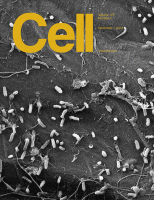
Luthria et al., 2024 (Cover image)
Delineating resistance to immune checkpoint inhibitors in patient models.
Immune checkpoint inhibitors (ICI) are exciting therapies that produce potentially durable responses in a portion of cancer patients, however, the vast majority of patients do not respond. We have previously identified a set of genes that are associated with drug resistance. We now use multi-scale genome-editing and single-cell genomics in patient-derived tumor/immune models to functionally to characterize putative drivers of resistance. This work is supported by NIH grants (R01CA266446) and foundation funding (Burroughs Wellcome Fund Career Award for Medical Scientists, Melanoma Research Alliance Young Investigator Award)

Tirosh, Izar et al., 2016

Izar, Tirosh, Stover et al., 2020

Melms et al., 2021

Wang, Fan et al., 2023

Tagore, Caprio, 2025
Dissecting tumor heterogeneity with single-cell genomics
Single-cell genomics, including multi-modal single-cell sequencing and spatial transcriptomics, are powerful tools to dissecting tumor heterogeneity, cellular interactions and biomarkers of drug response/resistance. In the lab, we have contributed to the evolution of these methods, both experimentally and analytically, and continue to strive to enable their implementation in clinically relevant contexts and model systems. Among others, we identified pre-existing, transcriptionally defined cells that confer resistance to oncogene-directed therapy, applied these methods to clinical specimens from COVID-19 patients, and most recently enabled their application to a variety of archival patient specimens. These methods are integral to questions asked in the lab. This work is supported by NIH/NCI grant U54CA274506 (Project 2).

Walsh, Shah, 2024

Walsh et al 2025
Cell engineering and functional variant mapping
Next-generation sequencing is now deeply integrated in clinical diagnostics of various genetic disorders, such as inborn errors of immunity. A central diagnostic challenge however is that most genetic variants found through sequencing cannot be classified as either benign or pathogenic and are labeled variants of uncertain significance (VUS). To begin not only reading a person's genome, but also attributing meaning to variants, we established massively scalable CRISPR-dependent base editing tools, performed directly in primary human T cells, which enable generation and mapping to phenotypes of interest. These approaches enable accelerated diagnosis and treatment implementation, as we have shown for Activated PI3K-delta syndrome, and provide a blueprint for annotating other gene-disease pairs in a similar manner. Furthermore, we reason that learning from these "experiments of nature" will inform targeted modifications to improve T cell function and therefore the building block for cellular cancer therapies. This work is funded by and NIH/NIAID R01 grant (R01AI199896), a CRI grant, and through additional foundations.